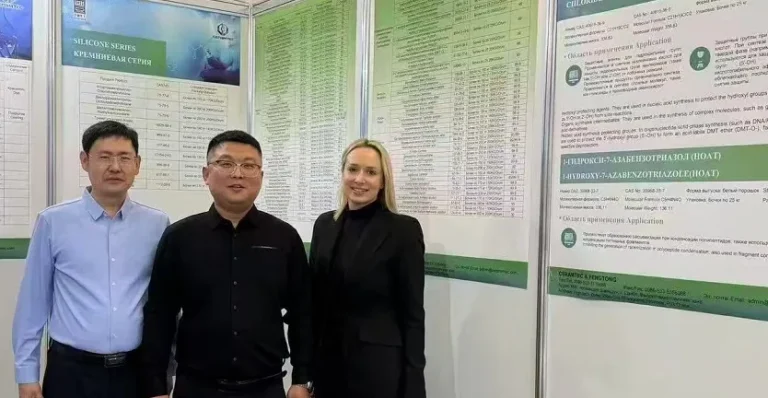
Trade show halls are designed to look alike: a banner, a counter, a row of labelled bottles, a stack of brochures. An hour into walking the floor, most stands blur into one.
The differences that matter to a buyer are rarely visible from the aisle. They sit in the paperwork, the packing and the person — three places worth spending your fifteen minutes. What follows is a short list of what to check, and what a good answer looks like.
01. Whose name is on the licence
Ask to see the hazardous-goods packing licence and the inspection and quarantine registration. These are the documents that decide whether your container moves or sits.
The detail worth reading is the name on them. A supplier that holds these licences in its own name can pack, label and declare dangerous goods itself. A supplier that holds them through a partner is handing your cargo to a third party whose standards you have not assessed — and whose delays become your delays.
Good sign: the certificates are produced without hesitation, in the company’s own name.
Warning sign: “our forwarder handles that.”
02. The document folder, not the brochure
Anyone can print a brochure. Ask instead to see a real certificate of analysis from a recent batch, and a safety data sheet in the format your market requires.
What you are checking is not perfection but habit — whether the supplier treats paperwork as part of the product or as an afterthought. Look at whether the COA is batch-specific or a generic template, whether the SDS follows GHS structure, and whether a certificate of origin is something they raise before you do.
Good sign: a current COA and SDS, offered as a matter of course.
Warning sign: documents “available later, once you place the order.”
03. A packing sample you can handle
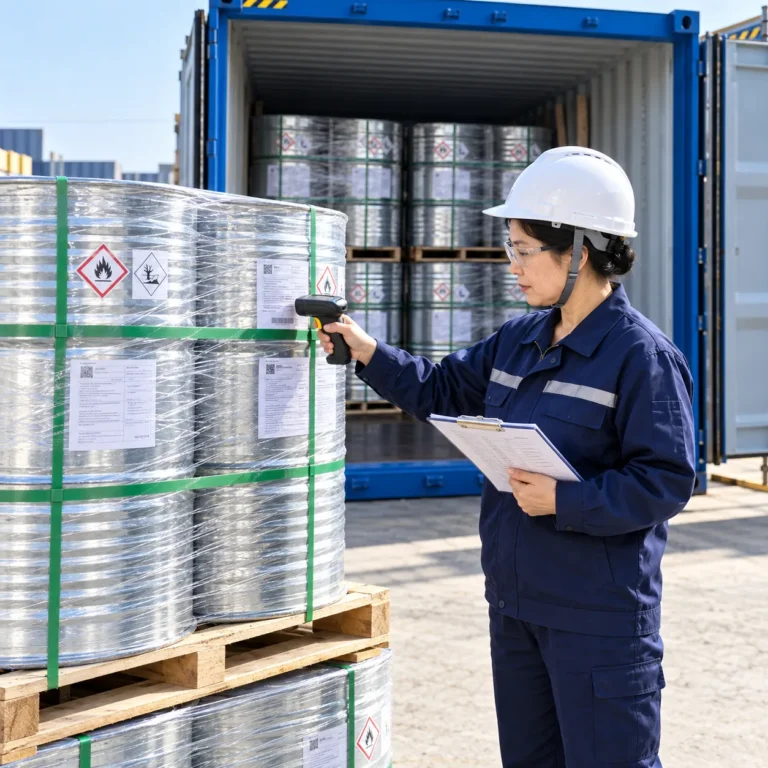
Photographs of drums tell you very little. If the stand has a 200 L drum, a 1,000 L IBC or ISO tank fittings on display, pick them up, read the labelling, look at the closures.
Packing is where complaints originate — a liner that reacts, a label that will not survive a humid port, a closure that weeps in transit. A supplier that repacks in its own warehouse can adjust these details on request. One that forwards someone else’s drums usually cannot.
Good sign: packing samples on the stand, and a supplier able to discuss liner and label specifications.
Warning sign: “standard export packing” as the only answer available.
04. Whether the person knows the chemistry
Specification tables are easy to copy. Understanding is not.
Ask something a datasheet cannot answer: how this grade behaves in a customer’s process, which impurities are typical, why one salt would be chosen over another. You are not looking for a laboratory answer — you are checking whether the person in front of you has handled the product, or only the price list.
Good sign: the answer contains a reaction, a constraint or a trade-off.
Warning sign: every question comes back to “we can meet any specification.”
05. How they answer a question they do not like
This is the most useful test, and the quickest to run. Ask about delay: what happens when a container is held at customs, when a batch misses specification, when a promised date slips.
Every supplier will tell you it does not happen. The informative part is what follows. A supplier with a real operation can describe the sequence — who is notified, how quickly, and what the alternatives are. A supplier without one changes the subject.
Good sign: a specific process, described in stages rather than assurances.
Warning sign: “that never happens.”
What the five have in common
None of these checks requires the supplier to be the largest in the hall. All five require the supplier to be specific — about paperwork, packing, chemistry and failure. Specificity is difficult to fake across a counter, which is precisely why it is worth fifteen minutes.
For our part, here is what you would find at the Fengtong stand: a Hazardous Cargo Packing Licence and China Inspection and Quarantine registration held in our own name; our own repackaging warehouse and transport system; a COA, SDS and certificate of origin with every shipment; and specifications agreed in writing before production begins.
If you would like to run these five checks against us — at our next exhibition, or by email — the team can be reached at johnson@fengtongchemical.com or +86 18405339555.