Shopping Cart
🔥 These products are limited, checkout within
00m 00s

Two documents decide whether a chemical shipment clears customs and passes quality review: the COA and SDS. Here is how to read them, verify them, and request them from a Chinese supplier.
Two documents decide whether a chemical shipment clears customs, enters your warehouse and survives your own quality gate: the COA and SDS. Buyers who treat them as routine paperwork usually learn the difference between a COA and SDS at the worst possible moment, when the container is already at the port and the release deadline is hours away.
This guide explains what each document actually does, how to read the numbers on it, what to verify before releasing payment, and how to ask a Chinese supplier for the COA and SDS you really need. It is written for importers, distributors and industrial buyers handling solvent, intermediate and specialty chemical shipments.
If you are still comparing suppliers, read our guide on how to choose a chemical supplier in China first. This article goes one level deeper and deals only with the documents themselves.
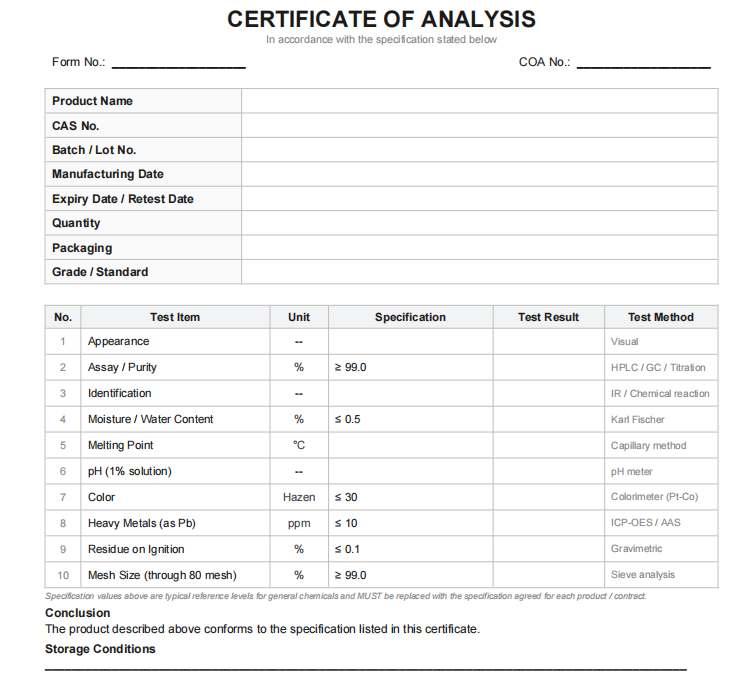
A COA is the batch’s report card. It records the specification for each parameter, the result that was actually measured, and the identity of the batch the result belongs to.
A usable COA answers four questions on one page: what was tested, what the acceptance limit was, what the measured result was, and which batch the result refers to. If any of those four pieces is missing, you are holding a marketing document rather than a quality record.
A complete COA normally includes:
Documents that show only typical values, with no batch number and no measured result, are specification sheets rather than COAs. Buyers comparing COA and SDS packages should always confirm which of the two they received, because the two documents carry very different weight in a quality claim.
A rejected batch costs far more than a few dollars per tonne saved. One off-spec delivery can mean re-testing, re-packaging, a production stoppage at your customer’s plant, and a container that has to be shipped back or sold at a discount. The COA is the first place where that risk becomes visible.
The SDS is the handling manual for a chemical. Where the COA describes quality, the SDS describes hazard: what the substance is, how it behaves, what it does to people and the environment, and what to do when something goes wrong.
Most SDS documents follow the 16-section structure defined under the GHS classification framework, which is why an SDS issued in Shandong can be read by a warehouse team in Jakarta or a surveyor in Rotterdam.
Freight forwarders, shipping lines and dangerous goods surveyors read the SDS before they accept a booking. If the transport section does not match the way your cargo is packed, meaning the UN number, hazard class, packing group and marine pollutant status, the booking can be refused after the container has already reached the terminal. Checking the COA and SDS before booking, rather than after, is what keeps a shipment on schedule.
The two documents are complementary and never interchangeable. The table below summarises the practical difference for a buyer preparing an import.
| COA | SDS | |
|---|---|---|
| Full name | Certificate of Analysis | Safety Data Sheet |
| Answers | Is this batch within specification? | How do we handle, store and ship it safely? |
| Owned by | Quality and procurement teams | Warehouse, logistics and EHS teams |
| Batch specific | Yes, ideally | No, product or formulation specific |
| Typical failure | Values that do not match your specification | Outdated transport or hazard data |
| Regulatory weight | Contractual and quality evidence | Handling and transport compliance |
In short, the COA tells you whether the product is what you ordered, while the SDS tells you how to move it without incident. A chemical import usually needs both, and the COA and SDS should describe exactly the same product identity, including grade and CAS number.
Receiving a document is not the same as reviewing it. These five checks catch most of the problems buyers run into when they review a COA and SDS set for the first time.
Confirm that the product name, grade and CAS number match your purchase order. Similar names exist across the solvent and intermediate range, and a COA issued for the wrong grade is worse than no COA at all.
Compare the measured result with the specification you wrote, not the one printed on the supplier’s letterhead. A COA can be internally consistent and still describe a product that does not meet your requirement.
The batch number on the COA should appear on the drum or IBC label and on the packing list. If it does not, the document cannot prove anything about the material inside your container.
Two laboratories testing purity by different methods can report different numbers for the same material. Check whether the method is stated and whether it is the one your own quality team uses.
Look for a named approver, an issue date, and a date of analysis that precedes shipment. An undated COA, or one dated after the vessel sailed, deserves a question.
An SDS is only useful if it describes the product you are actually importing. Six points cover most of the risk.
This is the step buyers skip most often. A COA can be genuine, internally consistent, and still worthless if it does not belong to the material in your container. Before releasing the balance, run these six checks.
None of this requires a laboratory at your end. It requires reading the COA and SDS as commercial documents rather than as certificates of good faith.
Not necessarily, and not in the same form. Requirements depend on the chemical, the destination and the mode of transport, and the depth of the COA and SDS package you need should be agreed before the order is placed.
Industrial solvents moving in ISO tanks between experienced traders may need little beyond a COA and a transport SDS. A regulated intermediate entering a pharmaceutical supply chain may require batch-specific COAs, retained samples and full traceability. Confirm the requirement with your customs broker and, where relevant, with your customer’s quality department before the order is placed.
For buyers shipping into Malaysia, Indonesia, Thailand, Vietnam or other Southeast Asian markets, the practical rule is simple: ask the destination question early, because the answer changes what the COA and SDS must contain.
The COA and SDS rarely travel alone. Depending on the transaction, expect some of the following.
When these documents disagree with one another, banks and customs stop the transaction. The COA and SDS belong to that same document set, which is why they should be issued before the container is sealed rather than after.
A clear request saves a week of email. Include the following in your first message.
Then ask two direct questions: when will the COA and SDS be issued, and who issues them. A supplier who cannot answer both clearly is telling you something useful about how your order will be documented.
Reviewing the COA and SDS before you confirm an order is normal practice, not a sign of distrust. Reputable suppliers expect it.
No. The COA reports measured quality results for a batch. The SDS reports hazard, handling and transport information for the product. One is evidence about a shipment, the other is an instruction manual for anyone who touches it.
At minimum: product name and CAS number, batch number, the specification and measured result for each parameter, test methods, and the date and signature of the person authorising release. Purity, moisture, colour and density are the usual parameters for industrial solvents.
A trading company can forward the producing plant’s COA, and many do so correctly. What matters is the origin of the document. Ask for the plant’s original COA with its batch number, and treat a document re-typed on trading company letterhead as a secondary source.
Most industrial chemicals shipped internationally travel with an SDS because carriers and regulators expect one, and the COA and SDS are normally requested together. Format and language requirements vary by destination, so confirm the local expectation before booking.
There is no single global expiry date, but an SDS should be revised whenever the formulation, hazard classification or applicable regulation changes. In practice, a document more than three years old warrants a request for the current version.
Yes, and you should ask. Suppliers can normally share a typical specification and a current SDS straight away, with the batch-specific COA issued after production. Agree in writing when that batch COA will be provided.
Fengtong Chemical supplies industrial solvents, pharmaceutical intermediates and specialty chemicals from China to buyers in Southeast Asia, South Asia and Africa. Our work covers sourcing, specification matching, packaging and export documentation.
Documentation is part of the offer rather than an afterthought. For every order we state whether the COA and SDS come from the producing plant or are prepared by our own document desk, and we send both for your review before the container is sealed.
Send us your requirement, including chemical name or CAS number, grade, quantity, destination port and the documents you need, and we will reply with availability, price and the COA and SDS for your evaluation.
Get in touch through our contact page, or review our product range and our factory and packaging capabilities.
8-Hydroxyquinoline: Uses, Specs and a Buyer’s Checklist When sourcing 8-Hydroxyquinoline from China, product specifications, purity, batch documentation, packaging, transportation requirements, and supplier reliability all affect a…
Read MoreA practical guide for Southeast Asian buyers on choosing a reliable chemical supplier in China: supplier types, COA and SDS documentation, factory qualifications, packaging, Incoterms, and…
Read MorePhenolphthalein is a well-known chemical compound widely used as an acid-base indicator in laboratories and analytical chemistry. Its distinctive color change under different pH conditions makes…
Read MoreCustom synthesis, process development, CDMO, and OEM — our technical team delivers from milligram to metric-ton scale.
Contact Our Experts ↗